
Why Consistent Dehusking Matters: The Role of Precision Components in Rice Milling Efficiency
Table of Contents
Why Consistent Dehusking Matters in Rice Milling
Consistent dehusking is one of the most critical yet often underestimated stages in the rice milling process. It directly impacts head rice yield, grain quality, broken rice percentage, milling recovery rate, and overall profitability. Whether you operate a mini rice mill or a large commercial plant, uneven or poorly controlled dehusking can lead to significant losses.
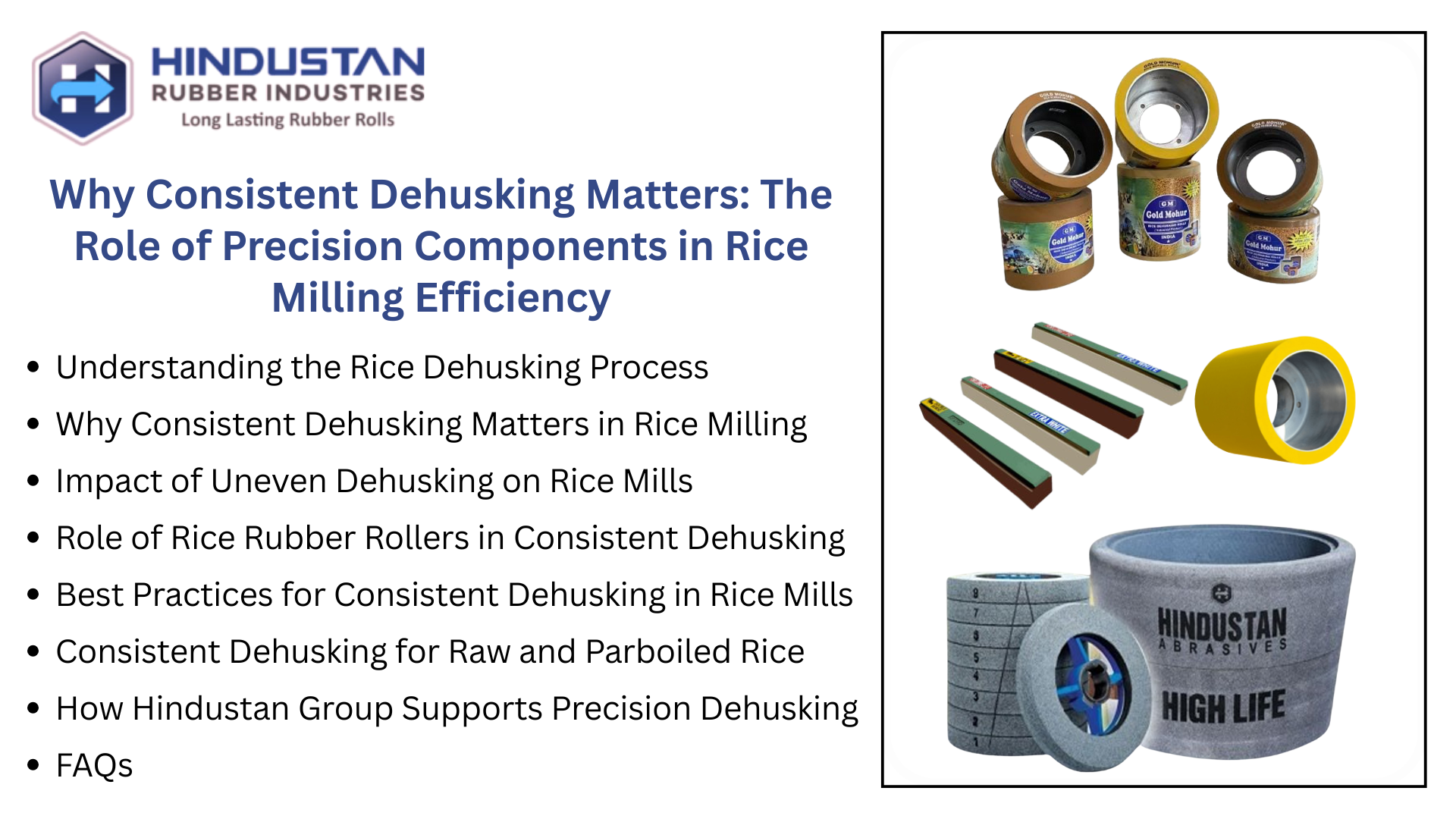
In this blog, we explain why consistent dehusking matters, how it affects rice quality and yield, the role of rice rubber rollers, and how millers can improve dehusking efficiency in rice mills with the right components and practices—supported by industry expertise from Hindustan Group.
Understanding the Rice Dehusking Process
The rice dehusking process (also known as husking or shelling) involves removing the outer husk layer from paddy while keeping the grain intact. This stage prepares the rice for subsequent steps such as separation, whitening, polishing, and grading.
Key components involved in dehusking include:
- Rubber roll shellers
- Rice rubber rollers
- Controlled pressure and alignment systems
- Proper feed rate and paddy moisture
If dehusking is inconsistent, it affects the entire downstream process, including polishing efficiency and final rice appearance.
Why Consistent Dehusking Matters in Rice Milling
1. Improves Head Rice Yield
Uniform husk removal ensures minimal grain breakage. When dehusking pressure is controlled, the rice kernel remains intact, increasing head rice yield and reducing losses.
2. Reduces Broken Rice Percentage
Uneven dehusking is a major cause of broken rice. Consistent dehusking in rice milling prevents excessive friction and impact, helping millers reduce broken rice during dehusking.
3. Enhances Grain Quality and Appearance
Proper husk removal improves grain integrity, leading to better whitening and polishing results. This directly impacts market value and export acceptance.
4. Improves Milling Recovery Rate
Stable shelling performance ensures optimal separation of husk and grain, increasing overall milling yield optimisation.
5. Lowers Operational Costs
Reduced breakage, lower reprocessing, and fewer machine adjustments result in improved efficiency and lower running costs.
Impact of Uneven Dehusking on Rice Mills
When dehusking is inconsistent, rice mills may face:
- Excessive grain breakage
- Poor husk separation quality
- Higher load on whitening and polishing machines
- Increased wear of rice milling components
- Reduced rice milling productivity
Common causes of uneven dehusking include:
- Worn or low-quality rubber rollers
- Improper rubber roll alignment
- Incorrect dehusking pressure
- Inconsistent paddy feed rate
- Variation in paddy moisture content
Role of Rice Rubber Rollers in Consistent Dehusking
The rice rubber roller plays a decisive role in achieving uniform husk removal. High-quality rubber rollers provide:
- Controlled grip on paddy
- Even pressure distribution
- Reduced slippage
- Longer service life
For long-grain and speciality rice varieties, such as basmati, using 1121 rice rubber rolls is essential for maintaining grain length and integrity. Similarly, parboiled paddy rolls are designed to handle tougher husk structures without damaging the grain.
Best Practices for Consistent Dehusking in Rice Mills
1. Maintain Correct Rubber Roll Alignment
Misaligned rolls lead to uneven pressure and inconsistent husk removal. Regular alignment checks are essential.
2. Control Dehusking Pressure
Excess pressure increases breakage, while low pressure results in incomplete husk removal. Controlled dehusking pressure ensures balance.
3. Use Application-Specific Rubber Rolls
Different paddy types require different roll compositions. Selecting the right rice rubber roller quality improves consistency.
4. Monitor Rubber Roller Wear
Timely replacement of worn rollers prevents performance drop and maintains uniform shelling.
5. Optimise Paddy Feed and Moisture
Uniform feed rate and controlled moisture content enhance dehusking accuracy and shelling performance.
Consistent Dehusking for Raw and Parboiled Rice
Dehusking requirements differ for raw and parboiled rice:
- Raw rice milling process: Requires softer pressure and higher sensitivity to avoid breakage
- Parboiled paddy processing: Needs stronger, heat-resistant rubber rolls due to hardened husk
Using specialised parboiled paddy rolls ensures consistent results across both processes.
How Hindustan Group Supports Precision Dehusking
Hindustan Group supports rice millers with high-performance dehusking components designed for durability and consistency, including:
- Rice Rubber Rollers
- 1121 Rice Rubber Rolls
- Parboiled Paddy Rolls
- Rice Polishing Wheels
- Rice Rubber Polisher Brakes / Sticks
- PF Resin for enhanced component life
Our solutions help millers achieve:
- Uniform husk removal
- Reduced broken rice
- Improved milling yield
- Long-term operational stability
Conclusion
Understanding why consistent dehusking matters is key to running an efficient and profitable rice mill. From reducing broken rice to improving grain quality and milling recovery, consistent dehusking directly influences every performance metric that matters.
By selecting the right rice rubber rollers, maintaining proper alignment and pressure, and partnering with Hindustan Group, millers can achieve reliable, high-quality dehusking across raw and parboiled rice operations.
👉 Optimise your dehusking performance today with precision-engineered solutions from Hindustan Group.
Explore the range of our Rice Whitener Stones by Hindustan Group
Rice Rubber Roller | 1121 Rolls | Par Boiled Paddy Rolls | Rice Polishing Wheel | Rice Rubber Polisher Brakes / Sticks | PF Resin
FAQs: Consistent Dehusking in Rice Milling
Consistent dehusking reduces broken rice, improves head rice yield, and ensures better grain quality throughout the milling process.
Proper dehusking minimises grain damage, leading to higher milling recovery and improved profitability.
Worn rubber rollers, misalignment, incorrect pressure, and inconsistent paddy moisture are common causes.
Using high-quality rubber rollers, maintaining correct pressure, and ensuring uniform feed rate helps reduce breakage.
Yes. Parboiled rice requires specialised rubber rolls to handle harder husks while maintaining grain integrity.